Titelgrafik EN
VDE
2026-10-15

European Future Technology Summit 2026 – EFTS Creating European resilience

Europe is increasingly facing attacks on critical infrastructure and hybrid warfare from the Russian sphere of influence. That places an increased focus on the ability to maintain central services despite disruptions. This shaped the discussions at the EFTS in Brussels in early September. The key takeaway: resilience is a basic requirement for European sovereignty, democratic stability, and economic competitiveness.

Kontakt
Markus B. Jaeger

The European Future Technology Summit (EFTS) organized by VDE and the European umbrella association, EUREL, has brought about exchanges between stakeholders in politics, industry, science, engineering, and security organizations for years now. In early September 2026, under the summit's motto “The Resilience Code,” attendees explored ways for Europe to strengthen its resilience.

Security is a task for society as a whole

Lieutenant General Wolfgang Wien, German Military Representative for NATO and the EU, described the security policy framework. Russia’s war is not just directed against Ukraine. The hybrid warfare also aims to undermine institutional trust in other European countries, and to impair governments’ ability to act. Wien’s message: resilience and security are not tasks that can be solved by governments or armies alone. They require involvement from every part of society - and especially from a strong generation of engineers.

A focus on civil systems

Stefan Schonauer from Hamburger Energienetzen cited the attack on Berlin’s power network in January 2026 as an example of how quickly a power outage can become a challenge for society as a whole, encompassing health care, public safety, transit, and telecommunications. One thing is clear: network operators, public authorities, and emergency and security services all need to be able to coordinate their 
activities even in times of great uncertainty. Civil systems should maintain important functions independently rather than depending on military support.

Energy infrastructure as a strategic goal

Kristina Rimkunaite from the NATO Energy Security Centre of Excellence used Ukraine as an example of how energy infrastructure has become a central target in modern warfare. Since the start of the full-scale Russian invasion, power, gas, and heating networks have been systematically attacked. Restoring the damaged systems, as of today, would take at least ten years and around 77 billion euros. An important lesson for Europe: joint crisis drills for suppliers, public agencies, scientists, and the military can help identify and prevent crises before they occur.

Communications are critical infrastructure

Galyna Rospopa from the Ukrainian utility company Lvivoblenergo and Marian Shvets from A-Solutions Development showed that citizens need precise, timely information about the cause, scope, and length of the disruption when there is a power outage. To do this, Ukrainian suppliers combine operational data systems with apps, chatbots, social media, and contact centers. Reliable communications reduce uncertainty, protect operational resources, and build trust. That makes them part of the critical infrastructure.

The five dimensions of resilience
VDE

Three additional workshops highlighted the technological building blocks of resilient systems. Marc Bovenschulte from VDI/VDE Innovation + Technik showed how fragmented markets and slow technology transfer put the brakes on Europe's innovative capacity. Reiner Thomä from TU Ilmenau presented mobile communication networks as an option for future sensor systems, for instance to identify drones. Stefan Liesner from SL Naturenergie pointed out that decentralized production, combined heat and power, and intelligent energy management are important building blocks of robust energy systems.

Before the workshop phase, participants visited the European Commission and the European Parliament. With Member of European Parliament Hildegard Bentele, they mainly discussed critical raw materials - the Critical Raw Materials Act is meant to reduce dependencies and secure the supply of raw materials for key European technologies.

VDE Summer Reception 2026: From "Security by Design" to "Resilience by Design"

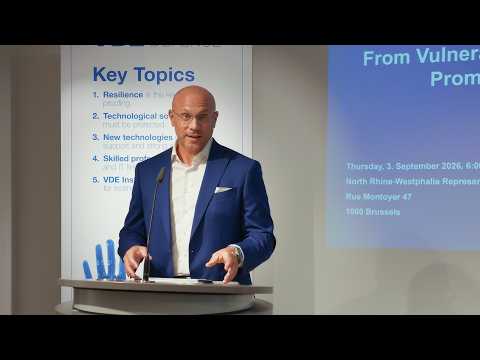
At his keynote during the VDE Summer Reception in North Rhine-Westphalia’s EU Representation, VDE Chairman Ansgar Hinz called for a paradigm shift: while the traditional security approach of “Security by Design” aims to prevent attacks, “Resilience by Design” assumes that disruptions can occur despite all the protective measures – and that systems will still need to maintain key functions and restore them quickly. Hinz combined this approach with technological sovereignty, future technologies and key technologies, as  well as audits and certifications as the basis for building trust.

Micha Comnick from the cabinet of the EU Commissioner for Defense and Aerospace Andrius Kubilius connected this with European defense policy. His keynote, “Defence Ready 2030,” focused on industrial readiness. Deterrence, he said, requires not just capable armed forces, but also resilient industrial ecosystems that can quickly ramp up their production capacity in the event of a crisis. Joint procurement, interoperability, and European production capacity thus become security factors. His message: “Deterrence is based on readiness – and readiness is based on industrial resilience.”

The human face of resilience was demonstrated in the conversation between Markus B. Jaeger, Global Head of Political Affairs of VDE and Head of VDE Defense, and Galyna Rospopa. The Communications Director of the Ukrainian utility company Lvivoblenergo described how Ukrainian families and utility companies continue their day-to-day activities and maintain their supply despite missile and drone strikes. Their experience shows that resilience comes mainly from people who take responsibility and are still able to act even under extreme strain.

Their message for Europe was brief: “Be prepared!” Resilience cannot emerge only during a crisis, but needs to be built up long before that.

Further topics in the VDE Digital Policy Brief