

Recent experience has shown that the technical due diligence community must do a better job of adapting solar farms to withstand the severe weather risks associated with a warming climate. In a review of claims data, climate insurance provider kWh Analytics has estimated that hail accounts for 6% of solar project insurance claims but more than 72% of losses by dollar amount. Moreover, hail-related solar project losses incurred since 2018 have exceeded $600 million—in the state of Texas alone.
As the leading state solar market in the most hail-exposed country in the world, Texas has emerged as the ultimate proving ground for PV technology climate resiliency. Solar project hail loss events in the Lone Star State have reached an unsustainable frequency and scale, putting a roadblock in the path of our collective efforts to avert a global climate crisis. However, if industry stakeholders can design PV modules and power systems capable of weathering severe convective storm environments in Texas, these resilient assets will provide a solid foundation to support power sector decarbonization as part of a global energy transition.
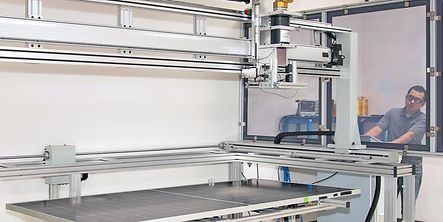
To prevent catastrophic hail losses in Texas, utility-scale solar farms must be able to withstand the ≥45-mm (≥1.77-in.) hail events likely to occur within an asset’s operational lifetime. Survival under these extreme conditions of use not only requires climate-adapted operational strategies—such as state-of-the-art hail monitoring and tracker stow capabilities—but also the availability of proven hail-hardened PV modules. To support the development and procurement of truly differentiated product designs, VDE Americas and RETC, part of the VDE Group, have partnered to introduce the Hail Resiliency Curve Test program—the industry’s first true measurement system dedicated to the development of hail-hardened solar assets.
Why pass/fail testing is failing now
In 1975, U.S. government-sponsored work began in earnest to develop cost-competitive PV module designs capable of supporting a large-scale terrestrial solar market. As part of the Flat-Plate Solar Array (FSA) Project, which ran from 1975 to 1986, the Jet Propulsion Laboratory (JPL) and the California Institute of Technology developed ballistic-impact testing techniques still used today to simulate and study the effect of hail on solar panels. As early as April 1978, these researchers described the process of subjecting commercially available PV modules to 25-mm (1-in.) simulated hailstones, identified in conference proceedings as “frozen ice spheres projected at terminal velocity,” and steel balls applied by gravity drop.
JPL’s groundbreaking work on the FSA Project was foundational to the development of the durability tests and performance standards that enable modern PV modules to withstand decades of field exposure. Analyzing probabilistic failure modes, the project’s reliability engineers defined many design qualification and product safety tests still relied upon today. To this day, we can still see JPL’s imprint on PV module ballistic-impact testing standards in the 50-mm (2-in.) steel ball drop test in IEC 61730 and the 25-mm (1-in.) freezer ice ball test in IEC 61215.
The fact that simulated hail testing standards derived from the FSA Project have largely served the industry well for more than 40 years speaks to the quality of the reliability engineering work done in the process of bringing a space-age technology down to Earth. Cracks in this foundation emerged only recently due to a perfect storm of solar technology and market trends.
On the technology front, solar panels have gradually become less hail resistant over time as manufacturers have pushed the value-engineering envelope with the introduction of ever-larger PV modules, often made with the thinnest possible front glass to control weight. With regards to markets, utility-scale solar project development activities have increased exponentially in the most hail-exposed region of the world—specifically, a distinct “hail alley” that extends north out of Texas along the eastern flank of the Rocky Mountains.
As if these intersecting trend lines were not enough cause for concern, climate scientists believe the effects of human-caused climate change have generally increased severe convective storm risk over the decades since JPL’s reliability engineers developed the industry’s prototypical PV module hail testing standards. This is the stage upon which the now-infamous $70 million Midway Solar Farm catastrophic hail loss event took place in May 2019, the shock waves of which still reverberate in solar insurance markets.
Current versus modeled future hail climate
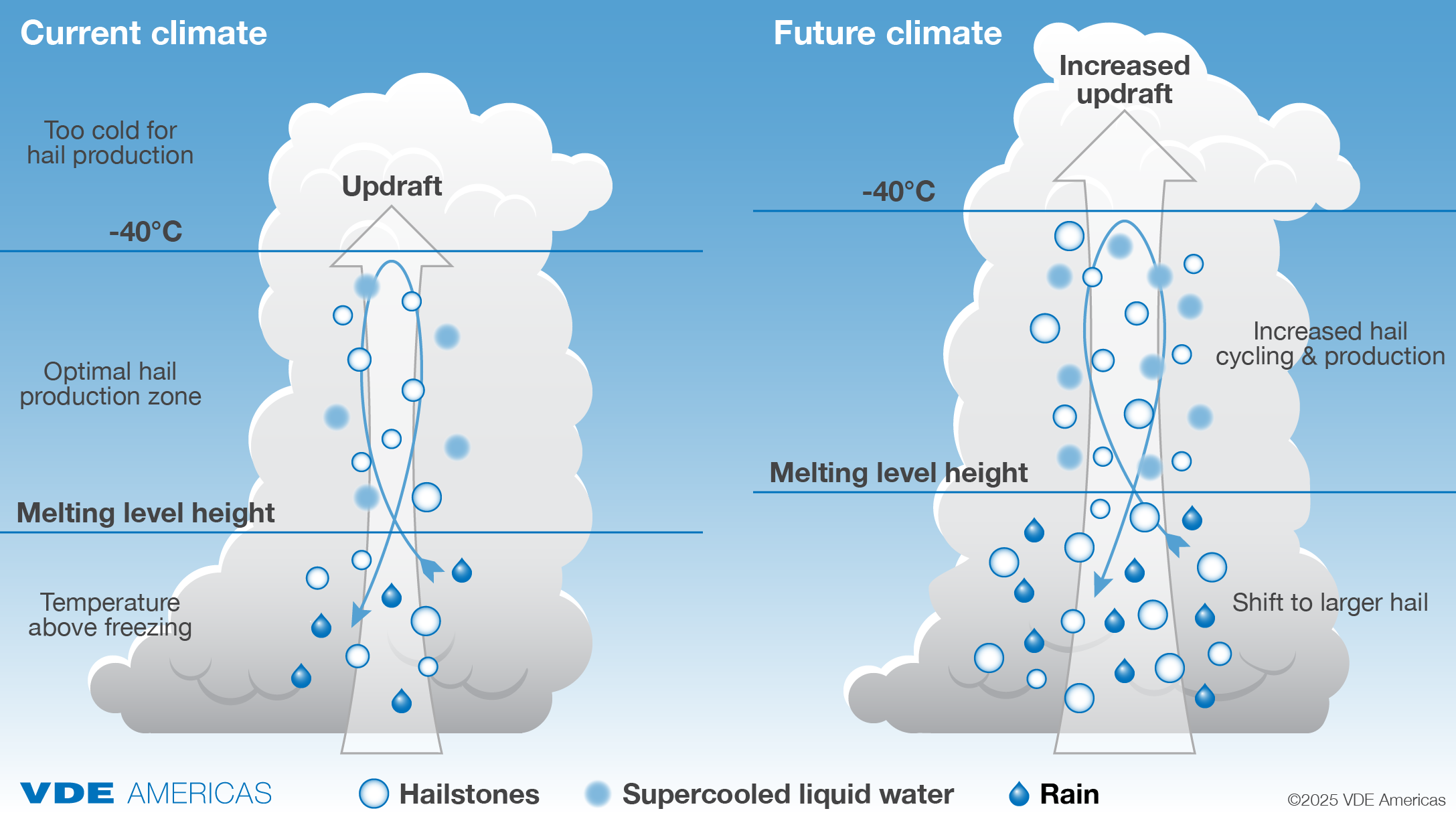
Climate models generally point to an increase in the annual number of hail days favorable to very large hail over the central and eastern United States.
| VDE Americas