

(SAN JOSE, Calif., March 10, 2026) VDE Americas, a global leader in technical advisory and catastrophic risk assessment for the solar industry, today announced that it has enhanced its proprietary Hail Risk Model with newly analyzed wind speed data, significantly improving the accuracy of hail damage predictions for solar power generation facilities.
Recent meteorological data analysis by VDE reveals that winds during hailstorms can be stronger than previously understood, with wind speeds at some locations more than doubling earlier estimates. VDE reached this conclusion after carefully filtering weather records to focus on events where hailstorms passed directly over weather stations across the contiguous United States. Stronger winds cause hailstones to strike panels more directly and with greater force, increasing the likelihood of solar panel breakage. By incorporating these more accurate wind speeds into its Hail Risk Model, VDE’s risk assessments better reflect real-world storm conditions.
"Wind speed and direction modify both the fall angle and impact energy of hail," explained Central Michigan University's Dr. John Allen, a leading expert on hail meteorology and loss modeling, and a consultant to VDE. "To effectively predict damage in the field, hail loss models need to account for the influence of wind. VDE's improved loss model better informs this extremely important piece of the puzzle by more accurately characterizing representative wind speed and direction during hail events."
VDE’s analysis of 2025 weather radar data indicates that very severe convective storms characterized by greater than 45-mm hail—a typical threshold for solar panel damage—occurred at or near dozens of utility-scale solar facilities. Despite the relatively high frequency of events, reported catastrophic losses were lower in 2025 than in previous years, potentially due in part to project operators’ increased adoption of hail stow protocols and severe weather alert services. Still, hail remains the number one catastrophic peril facing the solar industry.
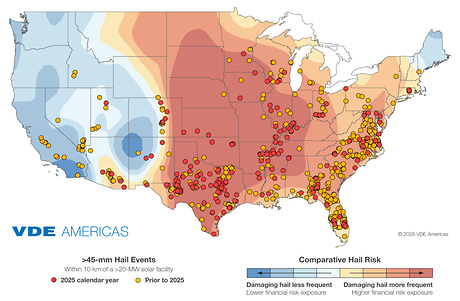
This meteorological data visualization shows potentially damaging hail events near operational utility-scale solar facilities commissioned prior to 2025, versus events near facilities that were fully commissioned or under construction in 2025.
| VDE Americas