

2025 Resilient Power Report
kWh Analytics
2025-11-12

VDE Americas case study featured in inaugural Resilient Power Report

kWh Analytics' new Resilient Power Report was developed as a complement to the Solar Risk Assessment to spotlight success stories across renewable energy and learn from projects that have proven their strength in the face of extreme weather.

Contact
Brian Grenko
Downloads + Links

Tech review of new defensive hail stow system confirms 100% success across multi-day severe convective storm outbreak in Arkansas

Rare but expensive catastrophic solar losses are on the rise as project development activities expand to hail-exposed regions in Africa, Australia, Europe, and North and South America. Earlier this year, climate insurance provider kWh Analytics reported that hail accounts for 6% of its solar project insurance claims by volume but roughly 73% of total dollar losses.1 Meanwhile, specialty insurer GCube has noted that its average solar hail claim expense is over $58 million.2 Automated stow protocols are increasingly deployed in utility applications to prevent physical damage and financial losses.

The Challenge

Proving these hail defense systems work reliably in advance of extreme weather events remains a critical technology verification gap. In a post-event forensic investigation explained in the 2025 Solar Risk Assessment, VDE Americas found that defensive hail stow protocols successfully prevented widespread physical damage at three utility-scale solar farms in Fort Bend County, Texas, during multiple one-in- 500-year hail events in mid-March 2024. Given that PV module hail damage at the exposed sites was isolated to a small portion of one PV power plant that did not achieve hail stow due to a pre-existing tracker motor issue, investigators concluded that overall site damages could have been much worse if not for operational hail stow protocols.3

Though the Fort Bend County forensic investigation’s findings are promising, many in the insurance, investor, and technical due diligence community invariably ask: “How can project stakeholders have confidence that operational hail stow measures will work as intended when needed?”
The Resolution

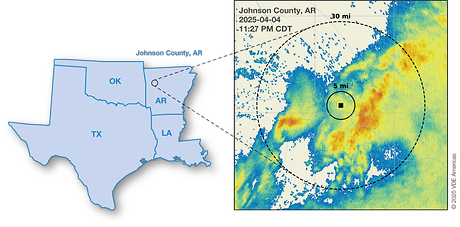
VDE Americas and GameChange Solar, a single-axis tracker manufacturer, collaborated on a real-world hail stow verification study for a hail-exposed solar site in Johnson County, Arkansas (Figure 1). The investigators reviewed system and meteorological data for April 2025, focusing on three consecutive days during which severe convective storms passed near the site. Researchers examined data from every step of the defensive hail stow operation: weather service alerts, automated master controller activation, and hail stow confirmation using controller status as a proxy for in-field tracker position.


CaseStudyMap

Figure 1. The approximate location of the study site in Johnson County, Arkansas, and a snapshot of weather radar data at the start of a severe convective storm approximately 20 miles to the west-southwest of the site. Note that the project (black square) is centered within 5- and 30-mile radii with different triggering alert criteria.

| VDE Americas

The Outcome

In early April 2025, Arkansas experienced a tumultuous weather pattern marked by severe storms, record-breaking rainfall, and deadly flooding. Severe thunderstorms generated hail as large as 3 inches in diameter.4 The site discussed in this study was prepared (Figure 2). As the storms drew near, weather alerting services from DTN and Vaisala XWeather merged Next Generation Weather Radar (NEXRAD) data with meteorological models to rapidly predict the size and location of hailfall. GameChange Solar processed these alerts and directed the trackers to stow at a steep angle within minutes.

Weeks later, VDE Americas examined engineering and meteorological data to verify that this complex real-time system worked as designed. The study verified that the automated system operated as designed; it

  1. queried the weather service APIs every 2 minutes,
  2. signaled hail stow activation within a minute of receiving a triggering alert,
  3. executed the hail stow command, and
  4. maintained the defensive stow position until the storms had passed.

During the study period, six systems of severe thunderstorms generated hail within 30 miles of the site, with the nearest hail observation only 4.4 miles from the site. Hail was observed within 30 miles of the site on every occasion that the system went into hail stow; thus, the system had no false activations. The minimum buffer between radar-based hail observations and stowed trackers was 14.4 miles.

Automated hail alerting and stow requires the coordinated operation of weather radars, meteorological modeling, alert retrieval and processing, and tracker positioning in real-time. Since communication or hardware issues could compromise this system, periodic testing and maintenance are critical to reliable operations.5 Independent technical due diligence, including engineering and meteorological verification of these complex systems in operation, can provide evidence that hail stow systems perform as designed to mitigate catastrophic hail losses. Moreover, case studies have shown that solar assets with properly implemented and documented hail defenses can qualify for evidencebased insurance premium reductions.6


CaseStudyOutcome

Figure 2. This sequence shows that the tracker controller has properly activated hail defenses in response to triggering alert criteria (left), and 62 minutes later, the system remains in hail stow when the storm system generates hail alerts within 5 miles of the site (right). Note the record of hail observations to the west of the site.

| VDE Americas

References

1. Fagan, R., “Hail Accounts for 73% of Total Losses by Damage Amount, Despite Representing Only 6% of Loss Incidents,” Solar Risk Assessment 2025, kWh Analytics

2. Hail No! Defending solar from nature’s cold assault, Q4 2023 Report, GCube

3. Previtali, J., “Study Shows 100% Hail Stow Success Despite Severe Storm Exposure,” Solar Risk Assessment 2025, kWh Analytics

4. “NWS Little Rock, AR – April, 2025 Monthly Summary,” National Weather Service, https://www.weather.gov/ lzk/apr2025.htm

5. Bostock, P., et al, “Best Practices for Hail Stow of Single-Axis Tracker-Mounted Solar Projects,” VDE Americas & Wells Fargo, February 2024

6. “Case Study: Resilient Assets Command Better Coverage,” kWh Analytics, September 2024


CaseStudySocial
kWh Analytics

About the author

Jonathan Ostrom Allen

Jonathan Ostrom Allen

| VDE Americas

Jonathan Ostrom Allen, PE, Director of Hail Risk | VDE Americas

With over 30 years of experience in data analytics and scientific research related to the electric utility industry, Jonathan Ostrom Allen contributes to the development and advancement of natural catastrophe modeling products and services, mitigates technical risks for customers, and oversees operational hail stow verification studies for equipment manufacturers and project owner-operators. Previously, Jon specialized in ambient air quality and air quality control research, with a focus on coal-fired power plants. For these studies he determined the effect of power plant operations on control efficiency, developed empirical process models, and recommended changes to improve mercury control. Jon has authored 30 peer-reviewed publications, 13 conference papers, and 55 technical reports. In addition to BS degrees in Chemical Engineering and Finance from University of Pennsylvania, Jon holds an MS and a PhD in Chemical Engineering from the Massachusetts Institute of Technology.

You may also be interested in this