Electric car lithium battery pack and power connections
Battery Testing and Certification at VDE
Request a Quote
Current Events
Read more
Contact
VDE Testing and Certification Institute
VDE Institute News
Read more
Looking for Studies, Position Papers or Standards?


> VDE Verlag

In the Shop of the VDE Publishing House you will find electrotechnical safety standards and books.


More knowledge, more success!

Many publications, VDE Studies, magazine subscriptions and books are price reduced for VDE members. Become a VDE member now!

Battery Testing and Certification at VDE

VDE helps bring your batteries safely to market. We test and certify cells, modules, and battery packs according to the latest standards and award recognized certification marks for global market access. In our state-of-the-art laboratories, experienced engineers support you throughout the entire development process, from technology assessment and cell selection to comprehensive electrical and mechanical testing and final certification. Even after production launch, we ensure ongoing product quality through continuous testing and surveillance measures.


What Requirements Apply to Manufacturers and Importers?

Icon Alert
VDE

Manufacturers of electrical products with integrated batteries face new and demanding requirements within the European Union. With the EU Battery Regulation (EU) 2023/1542, the EU has established a harmonized legal framework governing the entire battery lifecycle. For manufacturers, this means that only products fully compliant with these complex requirements can continue to be marketed safely and legally within Europe.

At the same time, electrical products must continue to comply with the requirements of the EU Waste Electrical and Electronic Equipment (WEEE) Directive. The combination of these regulatory frameworks makes product compliance more challenging than ever before.


VDE Testing Services for Safe and Compliant Batteries

VDE certifies batteries for a wide range of applications, including power tools, household appliances, medical devices, electric vehicles, and energy storage systems. As a trusted partner, we support manufacturers and distributors in meeting all regulatory requirements. Through globally recognized CB certifications and the VDE certification mark, we help accelerate market access worldwide.

Request a Quote


Information About the VDE Testing and Certification Process

The testing and certification process for electrical products follows a structured, standards-based approach from the initial inquiry to successful certification. VDE supports manufacturers through every project phase, including during product development, ensuring regulatory requirements are incorporated early into design, layout, and component selection.

We receive your request for a quote, including a product description, target markets, technical specifications, desired certification marks, etc., through our sales department or the relevant technical department. 

We assess internal laboratory capabilities, identify standards, and evaluate the testing requirements.
Timeframe: Weeks 0–2

We will prepare a customized quotation for you, including a list of standards, a test plan, a timeline, and a cost estimate.
Timeframe: Weeks 0–2

Once the order has been placed, we will determine the number of test samples required. Upon receipt of the goods, we will prepare photographic documentation and confirm receipt to you.
Timeframe: Weeks 4–6

We perform all necessary tests on your product in accordance with your specific order. 
Timeframe: Weeks 6–12

During this phase, we begin preparing the first test reports and document any nonconformities with standards, if applicable. Should any arise, you will receive recommendations for improvement. If you wish to make corrections or changes to your product, additional partial tests will be required, which may extend the duration of the entire project.

Our independent certification body evaluates and verifies all test results (completeness check, confirmation of compliance with standards). A certification decision is then made (approval / conditions / rejection).
Timeframe: Weeks 12–16

Upon successful certification, we will issue your certificate, and you will receive the test report and, if applicable, a mark usage agreement. Manufacturers may now affix the certification mark to the product and market it.
Timeframe: Weeks 16–18

Once certification is complete, your product will undergo regular factory inspections, including production monitoring and random sampling. Upon expiration of the certificate, renewal or recertification is possible.

How Does VDE Support the Development of Safe and Compliant Batteries?

As a globally recognized brand, VDE stands for quality, independence, and trust in battery technology. With ISO/IEC 17025-accredited battery laboratories at international locations and an in-house certification body, VDE provides efficient and seamless services from testing through market approval.

Our engineers combine extensive expertise with active participation in international standardization committees. This allows us to anticipate future requirements and contribute directly to the development of tomorrow’s standards.

VDE’s Comprehensive Testing Portfolio – the foundation for high-performance, safe, compliant, and internationally successful batteries

Our testing capabilities cover the entire battery homologation process in a holistic and efficient manner:

  • Environmental simulation under real-world and extreme conditions
  • EMC and wireless testing for reliable operation
  • Cybersecurity testing for connected systems
  • Functional safety assessments
  • Life-cycle assessment and carbon footprint evaluations
  • Product safety testing according to international standards
  • Inspection and conformity monitoring throughout the supply chain
  • Support for global market access
Request a Quote

VDE Battery and Environmental Test Center
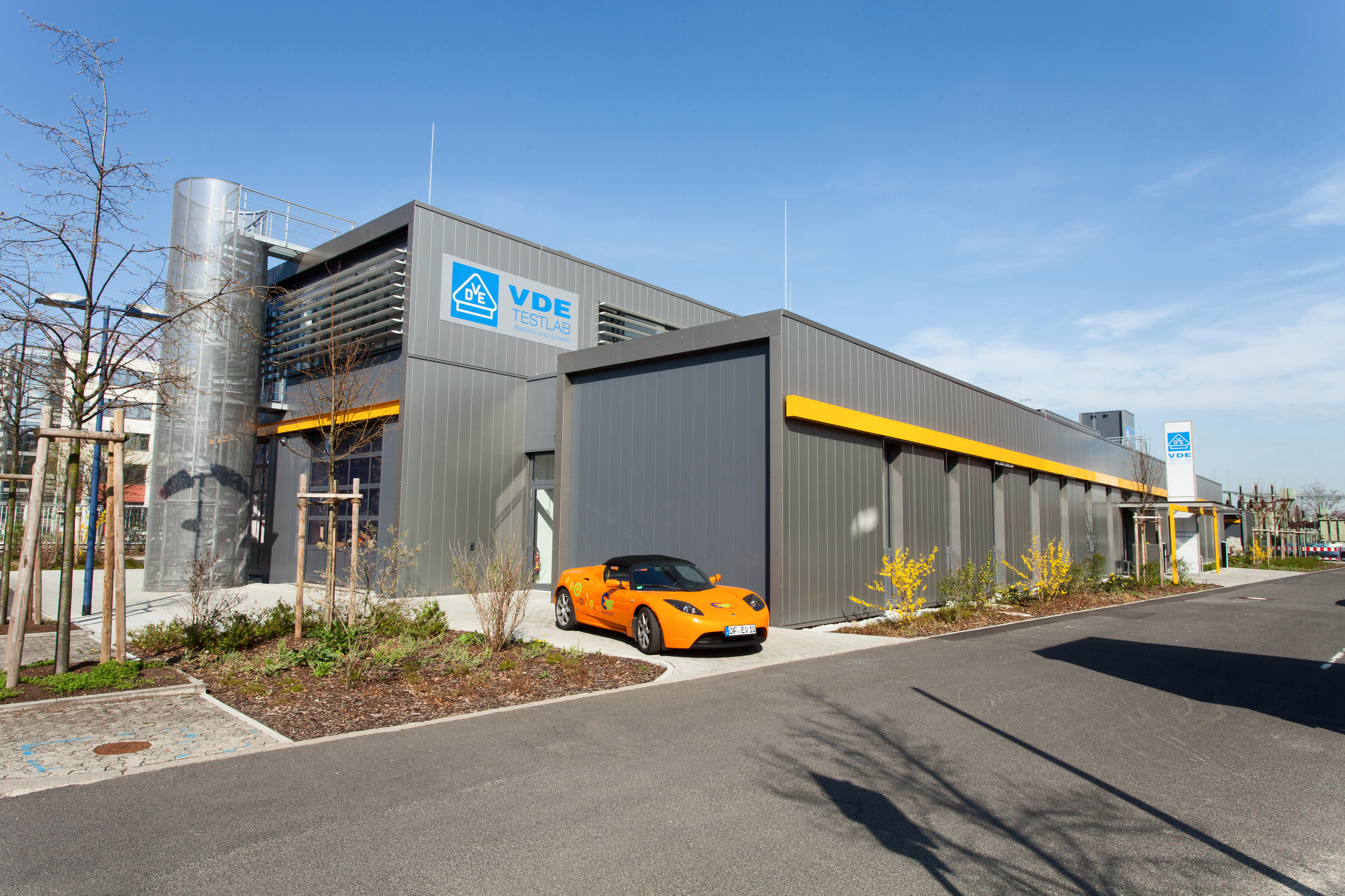
VDE operates advanced battery testing centers in Germany and China. Dedicated engineers can also conduct testing directly at customer sites when required.

The Offenbach facility is one of Europe's most advanced battery and environmental testing laboratories, providing more than 1,800 m² (19,400 ft²) of testing space. The laboratory is accredited according to DAkkS ISO/IEC 17025 and recognized under IECEE CB and TISAX ISO 27001, ensuring the highest levels of quality, data security, and international acceptance.

Here, we conduct electrical, mechanical, environmental, and destructive tests.


Electrical Testing

We cover the entire spectrum of performance and aging evaluation. This includes, among other things, measurements to determine capacity, Coulombic efficiency, DC internal resistance, AC impedance, C-rate behavior, self-discharge, SOC accuracy, as well as analyses of balancing, hot spot development, BMS functionality, and insulation resistance. Our state-of-the-art testing infrastructure includes 36 cell test channels (≥ 250 A), 24 module test channels, and 2 battery pack channels with voltages up to 1,000 V DC, currents up to 2,000 A, and power up to 700 kW.

Mechanical Testing

We have high-performance vibration systems capable of generating sine, half-sine, and customer-specific profiles. Several shakers with forces up to 120 kN, mounting surfaces of up to 1.2 x 1.2 m, and a maximum payload of 900 kg enable realistic stress tests—even in combination with superimposed climatic stress and electrical loading. In addition, we perform shock tests on test specimens weighing up to 900 kg.

Climatic Testing

We offer a wide range of environmental simulations: from calendar and thermal aging to temperature shock, altitude simulation, and corrosion testing, as well as IP protection rating tests and salt spray tests. Large batteries or charging stations can be tested in walk-in climate chambers with a volume of up to 43 m³. Temperature ranges from -70 °C to +180 °C and temperature change rates of up to 18 K/min enable extreme stress scenarios.

Destructive Testing

A separate abuse testing facility is available for these tests. Here, we conduct safety-critical tests—such as nail penetration, crushing, overloading, and short-circuit tests—in specially designed abuse chambers. These chambers are equipped with automatic fire suppression systems and connected to a flue gas scrubber to ensure the highest safety and environmental standards.

Tour of VDE battery laboratory


Upgrade for your knowledge: our free online seminars

Online Seminar
putilov_denis / stock.adobe.com

Through our free online seminars, we keep you informed about the latest developments in the testing and certification of electrical equipment and systems. Our experts discuss the latest trends as well as the perennial topics in the world of certification. In doing so, they draw on a wealth of experience gained over 100 years of testing and certification.

Register now

Is it all too complex and unclear?

Icon as question-answer speech bubble
VDE

We support both experienced engineering departments and manufacturers who are facing regulatory requirements for the first time.

Even if you have no prior knowledge, the VDE provides clarity on responsibilities, required tests, documentation requirements, and realistic timelines.

FAQs on Certificates of Conformity, Product Testing, and Certification of Batteries

Can VDE tell me whether my product meets market requirements?

Yes, VDE can help you assess whether your product meets the relevant market requirements. Our experienced experts have in-depth knowledge of standards, regulatory requirements, and technical testing procedures, and will guide you through the process from testing to the final assessment. You will receive a well-founded evaluation of your product’s conformity, safety, and marketability.

What legal regulations apply to my battery and my battery-powered device?

The VDE helps you reliably identify and implement the legal requirements that apply to your batteries and battery-powered devices. We have a comprehensive overview of national and international regulations and standards, and we work with you to analyze the specific requirements for your product. This provides you with clear guidance on all relevant requirements—from safety and transportation requirements to environmental and labeling obligations.

Do I need to register my battery or device somewhere before I can sell it?

Yes! The VDE can help you determine whether and where you need to register your battery or device before placing it on the market. As a general rule: If you place batteries or devices containing batteries on the market in the EU, you are typically required to register in the respective country under the Extended Producer Responsibility (EPR) framework (e.g., with national battery registries) and to organize their take-back and disposal. We help you clearly identify and correctly implement the registration requirements applicable to your product and your target markets—so you can bring your products to market in compliance with the law and without delays.

What tests are required to ensure that my battery is safe and compliant?

Typically, electrical, mechanical, environmental, and abuse tests are required to demonstrate safety during daily use, under reasonably foreseeable misuse or abuse, and during transport. Depending on the application—whether it’s a consumer device, e-mobility, or stationary storage—specific standard tests are applied. We ensure that all relevant tests are conducted thoroughly and in accordance with standards, so that your battery can be brought to market reliably, safely, and in compliance with the law.

What does the CE marking mean, and do I need it for my battery or device?

The CE marking indicates that a product meets the applicable EU requirements for safety, health protection, and environmental protection and may be sold freely within the European Economic Area. The CE marking is mandatory for many battery-powered devices (e.g., under directives such as the Low Voltage Directive, the EMC Directive, or the Radio Equipment Directive). For batteries themselves, the CE marking requirement stems in particular from Regulation (EU) 2023/1542, once the relevant conformity assessment procedures have been completed.

What documents do I need to prepare or keep on file to demonstrate compliance?

The VDE helps you prepare and organize all the necessary documentation for the conformity of your battery or device in a complete and accurate manner. Typically, you will need, among other things, technical documentation (e.g., design, bills of materials, risk assessment, test plans), test reports, and supporting evidence (e.g., safety, performance, and transport tests such as UN 38.3), labeling and product information (e.g., warnings, instructions for use), and evidence of compliance with regulatory requirements (e.g., sustainability, CO₂ footprint if applicable, recycled content). These documents must generally be retained for several years (typically at least 10 years) and submitted to market surveillance authorities upon request. We assist you in preparing, reviewing, and organizing your documentation—ensuring that your products are not only technically safe but also formally complete and legally compliant.

How can I make sure my battery is labeled correctly?

In general, batteries must bear various markings depending on their application and the applicable legal framework, including, for example, manufacturer or brand information, type designation, and identification features, as well as safety and warning notices. Additionally, depending on the application, further requirements may apply, such as those set forth in Regulation (EU) 2023/1542 or specific product standards. We verify the correct implementation of all labeling requirements for you and assist with the design and validation of your labels—ensuring that your battery complies with legal requirements and can be placed on the market without any issues.

What tests are required for lithium-ion batteries?

Among the most important required tests are transport tests in accordance with UN 38.3 (mandatory for the global transport of lithium batteries) and safety tests based on application-specific standards, such as IEC 62133 (portable batteries), IEC 62619 (industrial batteries), or other standards depending on the area of application. The specific tests required depend heavily on the application (e.g., consumer devices, e-mobility, stationary storage) and the target markets. We develop a customized testing plan for you and conduct all necessary tests—so that your lithium-ion battery can be brought to market safely, efficiently, and in compliance with regulations.

What safety requirements apply to the transport of batteries?

The transport of batteries—especially lithium batteries—is subject to globally harmonized regulations based on the UN 38.3 testing requirements. These tests are mandatory and demonstrate that batteries can safely withstand typical stresses such as pressure, temperature changes, vibration, shock, short circuits, or overcharging. In addition, depending on the mode of transport (air, sea, road, rail), further requirements must be met. We support you every step of the way—from test planning and execution to complete documentation—so that your batteries can be transported safely and in compliance with regulations worldwide.
 

What are my obligations regarding the recycling and return of batteries?

In general, Extended Producer Responsibility (EPR) applies under Regulation (EU) 2023/1542. This means that manufacturers, importers, or distributors are required to ensure and finance the take-back and environmentally sound disposal of their batteries. Key obligations include, in particular, registration in the respective national battery registry, organizing or participating in take-back systems, financing the collection, sorting, and recycling of used batteries, meeting collection and recycling targets, and providing end users with information on how to return batteries. We help you clearly identify your responsibilities and implement them in compliance with regulations—so that your products not only enter the market safely but are also handled sustainably at the end of their life cycle.

What is a battery passport, and does it apply to my product?

The Battery Passport is a digital record that provides important information about a battery throughout its entire life cycle—from manufacturing through use to recycling. The goal is to increase transparency, traceability, and sustainability throughout the entire battery value chain. Whether your product is affected depends primarily on the battery type and application. The Battery Passport is being introduced in phases and will initially apply mainly to larger batteries, particularly those used in electric mobility and industrial energy storage.


Additional Testing and Service Offerings from the VDE