


About this virtual "lunch and learn"
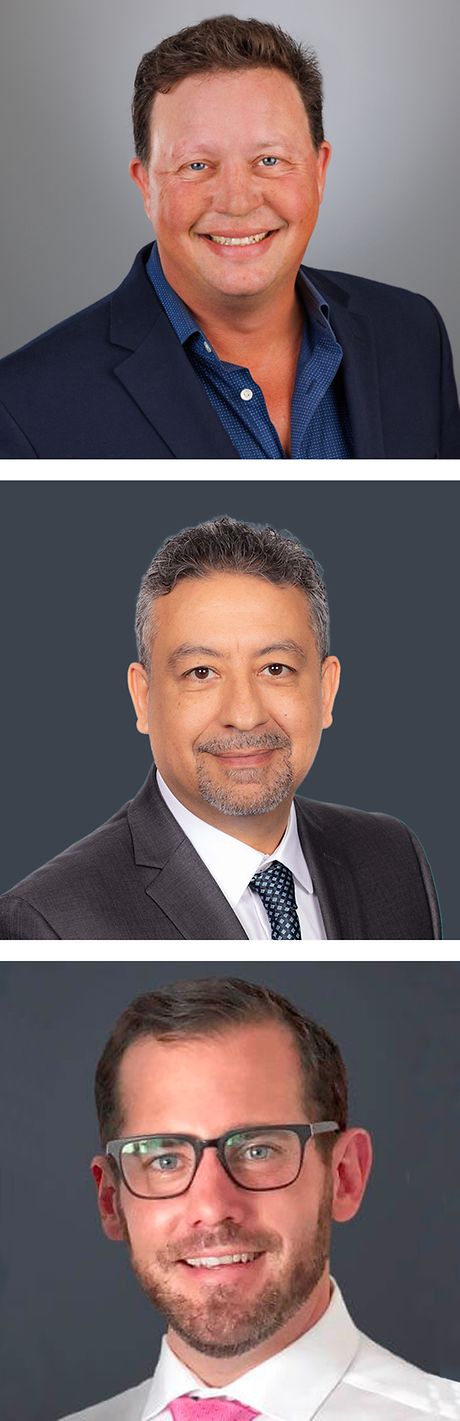
Who is presenting?
Jon Previtali is the vice president of VDE Americas and senior principal engineer overseeing the company's Hail Risk Intelligence and natural catastrophe consulting services. He is a 20-plus-year veteran of the solar power industry who has worked in project development, operations, asset management, finance, and engineering.
Cherif Kedir is a solar industry veteran of 18-plus years, with experience in product engineering and development, yield and performance enhancement, test site development, and durability, bankability and certification testing. He leads an RETC (Renewable Energy Test Center) team dedicated to helping the renewable energy industry thrive.
Mike Pilliod has played a pivotal role in launching and scaling up glass technologies for businesses including Apple and Tesla. He is the founder and president of Central Tension, which specializes in glass and materials engineering, product design and manufacturing development. Prior to this, he was the director of manufacturing innovation at Tesla Motors.
Why is this important?
Hail risk to solar assets is increasing as PV modules become less hail resistant through value-engineering with larger formats and thinner glass, while deployment expands in high-risk regions. As a result, specialty insurers report that hail accounts for 2% to 6% of solar project insurance claims by count but roughly 50% to 70% of losses by dollar amount.
Aiming to prevent rare expensive hail loss events before they happen, VDE Americas collaborated with RETC (Renewable Energy Test Center), a leading PV module testing laboratory, and Central Tension to develop VDE's new state-of-the-art Hail Resiliency Curve (HRC) Test.
The HRC Test uses a calibrated air cannon capable of precision targeting to shoot progressively larger freezer ice balls at increasing speeds until PV module glass breakage occurs. By providing a robust statistical representation of module reliability under real-world field conditions during severe hailstorms, this Weibull-based test-to-failure protocol can inform technology-specific engineered financial loss assessments and risk mitigation responses.
What will you learn about?
- How to model hail risk on a site- and technology-specific basis
- Technical factors that influence solar glass strength
- Traditional methods of testing glass strength and impact resistance
- Minimum impact testing requirements for IEC certification
- Differences between pass/fail and test-to-failure protocols
- How the HRC Test is designed and performed in the laboratory
- Product-specific HRC Test results for a hail-hardened PV module
- How HRC Test data are incorporated into engineered risk models