

About this virtual "lunch and learn"

Who is presenting?
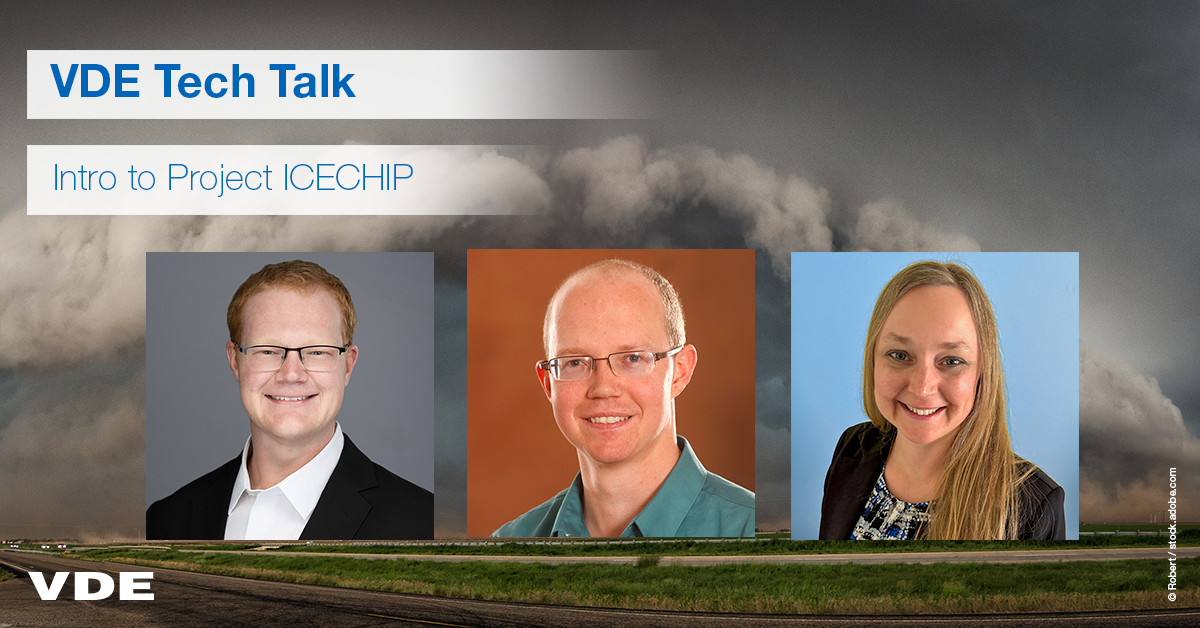
Dennis Weaver is a staff meteorologist for VDE Americas, where he applies his software development skills and meteorological knowledge to help de-risk large-scale solar assets.. Dennis began his meteorology studies at Central Michigan University, where he worked alongside Dr. John Allen researching the impact of reported damage descriptions on severe hail characteristics. While at Central Michigan, Dennis was selected as a NOAA Hollings Scholar and collaborated with researchers at the National Severe Storms Laboratory on the local economic impact of severe tornadoes. At Villanova University, Dennis produced a master’s thesis on projected changes in climatological hail risk and exposure across the United States.
Dr. John Allen is a Professor of Meteorology at Central Michigan University, originally from Sydney, Australia. Dr. Allen’s research primarily focuses on global severe weather observations and modeling, links between severe weather and the larger climate system, machine learning and statistical prediction of severe weather, and providing community and cross-disciplinary relevant risk and hazard resilience information. His ongoing work includes serving as one of the co-leads for the summer 2025 NSF-funded ICECHIP hail field campaign. Dr. Allen also currently serves as an Editor for the American Meteorological Society journals Weather and Forecasting, and Artificial Intelligence for the Earth Systems.
Dr. Rebecca Adams-Selin is a senior scientist at Atmospheric and Environmental Research at the Janus Group. Her research focuses on the microphysical characteristics of convection and thunderstorms: that is, how all types of precipitation within a storm, including hail, form, grow, and subsequently impact the storm that produced them. She is the lead principal investigator for Project ICECHIP, an editor for the American Meteorological Society journal Monthly Weather Review, and holds affiliate faculty positions at both Florida State University and the University of Wisconsin-Milwaukee.
Why is this important?
Hail is the most consistently damaging hazard associated with severe thunderstorms. In the United States alone, hail causes annual losses of over $10 billion, impacting homeowners, businesses, aviation, agriculture, transportation, and renewable energy producers. Hailstones pose a significant risk to U.S.-based utility-scale solar assets and portfolios, particularly those located east of the Rockies.
To improve the country's hail detection, modeling, forecasting, and warning capabilities, the National Science Foundation funded a massive meteorological field campaign known as Project ICECHIP—an acronym that stands for the "In-situ Collaborative Experiment for the Collection of Hail in the Plains"—which took place from May 18 through June 30, 2025. The primary goals of the project included obtaining comprehensive datasets on hail fall behavior, the physical properties of hailstones, and the relationships between these properties and the overall severe thunderstorm structure. These datasets and the resulting lessons learned will inform improved hail forecasting and hail risk modeling.
What will you learn about?
In this virtual lunch-and-learn, VDE Americas' staff meteorologist, Dennis Weaver, will host Dr. Rebecca Adams-Selin, lead principal investigator for Project ICECHIP and principal scientist at Atmospheric and Environmental Research at JANUS Research Group, and Dr. John T. Allen, principal investigator for Project ICECHIP and professor of meteorology at Central Michigan University. Together, the panelists will discuss Project ICECHIP's goals, research methods, initial findings, and key implications for solar project hail risk modeling and loss prevention.
Attendees will learn about:
- Overview of Project ICECHIP's primary science goals
- The instruments the researchers used and why
- How the research project is advancing hail science
- Which observations have implications for the solar industry
- How the work can improve hail risk mitigation strategies